 Espresso machine review · 8 min read
Sage Barista Express review: the grinder is the catch
An espresso machine and a burr grinder in one stainless box. The machine half is hard to fault at the price; the grinder half is what owners eventually outgrow.
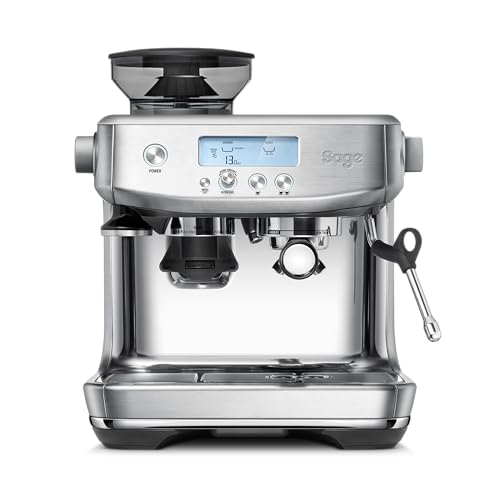
The Sage Barista Express is a manual espresso machine with a conical burr grinder built in, and it is the right buy if you want real espresso and steamed milk from one machine, one plug and one guarantee. It is £499 on Amazon at the time of writing (September 2026). It is the wrong buy if you want coffee at the press of a button, because you still grind, tamp, pull the shot and steam the milk yourself. It is also a poor fit if you already know you want light-roasted single origins, which its grinder struggles with.
A manual espresso machine with a capable built-in grinder: the simplest one-box route to real espresso, as long as you stick to espresso blends.
- Type
- Manual espresso machine with a built-in grinder
- Skill needed
- Some practice: expect a week of dialling in
- Best for
- Milk drinks from espresso blends, one or two people
Buy it ifYou want one machine that grinds, brews and steams, with one plug and one guarantee.
Skip it ifYou want coffee at the touch of a button; a bean-to-cup machine does that.

Who is the Sage Barista Express for?
Someone who wants café-style espresso and milk drinks at home, is happy to do the barista's job by hand, and would rather buy one machine than two. Sage lists a 15 bar pump with 9 bar extraction, a Thermocoil heater with PID temperature control, an integrated conical burr grinder with 16 grind settings, a 250g bean hopper and a 2 litre water tank. The grinder doses straight into a 54mm portafilter; everything after that is up to you.
Coffee Blog, which has reviewed it several times, puts the distinction plainly: it is a traditional espresso machine with a grinder built in, not a bean-to-cup machine, and when it comes to the espresso itself 'there's no assistance or automation'. That is the thing to understand before you buy. If you want to press one button and walk away, the Barista Express will disappoint you in the first week.
It has been on sale for about 12 years, by Coffee Kev's count in his 2025 review, and he still calls it a solid, reliable workhorse that is very hard to beat for the price. He adds that he has not found a cheaper lookalike whose grinder is as good.
How long does it take to learn?
Expect to throw away some coffee in the first week. TechRadar's Helen McCue started at the grind setting the manual suggests, got weak, under-extracted espresso, and went one notch finer each time. It took until the eighth cup, at setting 1, to get a properly extracted shot with a thick crema, and she had to raise the dose as the grind got finer. That is normal for an espresso machine, and it is the price of the control you are paying for.
Two things shorten the learning curve. The first is the adjustable upper burr: Sage's quick guide explains that if you run out of fine settings on the dial, you move the burr itself a step finer. Tom's Coffee Corner moves it from the factory setting of 6 to 2 before pulling a single shot. The second is buying the right coffee, which is covered below.
Once you are dialled in, the routine is short. TechRadar timed about 40 seconds to heat up from cold and 17 seconds to grind a dose, with the grinder the loudest part at 80dB. Tamping is where the mess happens: McCue found the grounds had to be piled high to give enough coffee, and some always ended up on the counter. More George, four years into ownership, uses a dosing funnel for exactly that reason.
How long it takes to be properly hot is where sources disagree. Coffee Kev measured roughly 30 seconds; More George says the group head takes 5 to 10 minutes to fully heat. Both can be right, because the water heats fast and the heavy metal parts do not. Sage does not publish a heat-up figure for this machine.
How good is the built-in grinder?
Good enough for espresso blends, and the reason people eventually move on. Coffee Blog says the grinder is 'better than many people give it credit for', but that it is designed for forgiving blends: with lighter roasts you may not be able to grind fine enough, and it lacks the grunt for denser beans. The retailer Alternative Brewing goes further, saying many owners 'eventually outgrow the grinder' and end up stuck between one setting that chokes the machine and the next that gushes.
The 16 steps are wide. Coffee Blog notes they are 'quite wide compared with newer machines', which matters little with blends and more with anything fussy. When beans are too hard for it, the grinder protects itself: Coffee Kev explains that the clicking you may hear is a slipper clutch, and that it usually means you are feeding it dense, light-roasted, high-grown coffee that entry-level grinders cannot handle.
So buy the coffee to suit the grinder. Coffee Kev's advice is medium-dark to dark roasts when the beans are freshly roasted, and he says almost any beans without a roast date will work. Sage's quick guide says to use the single wall baskets for beans roasted within 30 days and the dual wall (pressurised) baskets for coffee with no roast date or for pre-ground. Buying 1kg bags rather than 250g typically cuts the price per kilo by a quarter or more across the coffee we track.
Sources also disagree on brew pressure. Alternative Brewing says the Express 'notoriously brews at higher than 9 bar', which can flatten flavour. Sage says it extracts at 9 bar after low-pressure pre-infusion, and Coffee Kev says Sage fitted a 9 bar over-pressure valve a few years ago. If you are buying new, the more recent account is Coffee Kev's.
How does it handle milk?
Well, once you have learned to use a manual steam wand, and slowly by the standard of dearer machines. One heater does both brewing and steaming, so you pull the shot and then switch to steam. Coffee Kev timed about 1 minute 20 seconds to steam 170ml of milk to 60°C, including the wait for steam, and about 10 seconds before the machine was ready to brew again. TechRadar measured roughly 12 seconds for steam to come up.
Owners say it works but is not powerful. More George, after four years of daily flat whites, says the steam pressure 'is not the greatest' and takes a while to get going, though he still pours latte art with it. If steaming speed matters to you, Coffee Kev timed the Sage Barista Pro at about 45 seconds for the same 170ml. Sage's quick guide notes that steam cuts out after 5 minutes of continuous use, which you will only meet steaming for a crowd.
What goes wrong after a few years?
Scale, mostly, and it is preventable. More George's machine clogged in a hard-water area: it started leaking from the group head and lost pressure at the steam wand and hot water outlet, which he first took for failing valves. Switching to filtered water cleared it. Tom's Coffee Corner opened a colleague's Barista Express that had stopped delivering water and found the heater so furred with minerals that water could not get through.
Sage's guidance is specific. The quick guide says to replace the water filter every three months or 40 litres, and to descale every 90 days at water hardness level 4 or every 60 days at level 6. If you live in a hard-water area, treat those intervals as a rule.
Beyond scale, the long-term reports we could open are positive. More George has made four to six coffees a day on his for four years and says it 'hasn't skipped a beat'. Coffee Blog says the burrs do wear, although 'you do have to grind a lot of coffee to see any burr wear', and the adjustable upper burr lets you compensate when they do.
What does a year of coffee cost through it?
About £460 in beans at two drinks a day, if you pay the median price of the whole bean coffee we track. That median is 63p a cup on an 18g dose, across 812 products. Two a day for a year is 730 drinks, and 730 at 63p is £459.90.
| What you pay for | Per drink | Two a day for a year |
|---|---|---|
| Whole beans at our median | £0.63 | £459.90 |
| Coffee-shop flat white at £3.50 | £3.50 | £2,555.00 |
| Coffee-shop flat white at £4 | £4.00 | £2,920.00 |
Against a £3.50 flat white, each drink made at home saves about £2.87 in coffee, so the £499 machine has paid for itself after about 174 drinks: roughly 12 weeks at two a day. That leaves out milk, which the café price includes and your home cup does not, so the real break-even comes a little later.
Consumables are small next to the coffee. By Sage's schedule you change the water filter four times a year, descale every two or three months, and run a cleaning tablet through when the Clean Me light comes on. Sage's own 12-tablet pack is about £19 on Amazon at the time of writing.
What are the alternatives?
If you want the separate-grinder route, the Sage Bambino Plus is £349.95 on Amazon at the time of writing (September 2026), and with a Sage Smart Grinder Pro at £189 the pair comes to £538.95, about £40 more than the Barista Express. Coffee Kev's view is that the Barista Express is not really any easier to use than a Sage Bambino paired with a Smart Grinder Pro, so convenience is a weaker argument for it than it looks.

If you want to keep everything in one box, with a finer-adjusting grinder and faster steam, the Sage Barista Pro is £599.95 on Amazon at the time of writing. Coffee Kev's rule of thumb is that the more you expect espresso to become a hobby, the more likely you are to prefer the Pro.
The two Sage routes, costed side by side, are in our head-to-head. Sage Barista Express vs Bambino Plus
What warranty do you get in the UK?
Sage gives a 2 year repair, replace or refund guarantee, at its discretion, according to its UK product page. Your statutory rights sit alongside that and run through the seller: GOV.UK's guidance says a retailer must repair or replace a faulty item returned within six months unless it can prove the fault was not there when you bought it, and that you have up to six years to make a claim (five in Scotland). Keep the Amazon order confirmation.
- Sage, the Barista Express product page (UK)15 bar pump with 9 bar extraction, Thermocoil and PID, 16 grind settings, 250g hopper, 2 litre tank, 1,850W, 31.8 x 35.1 x 40.4cm, 2 year guarantee, £629.95 RRP.
- Sage, the Barista Express quick guide (BES875/SES875)Adjustable upper burr, which basket to use for which coffee, filter every three months or 40 litres, descaling every 60 to 90 days by water hardness, steam cut-out after 5 minutes.
- TechRadar, Sage the Barista Express review (Helen McCue)Eight shots to dial in, about 40 second warm-up, 80dB grinding, messy tamping, 12 seconds for steam.
- Coffee Blog, Sage Barista Express reviewWhat the grinder can and cannot do, the adjustable upper burr, burr wear, and the pressure gauge's missing bar markings.
- Coffee Kev (YouTube), Sage/Breville Barista Express, Still Worth It in 2025?About 30 second heat-up, 9 bar valve fitted in recent years, 91 to 95°C brew temperature, steaming times, comparison with the Barista Pro.
- Coffee Kev (YouTube), 5 Most Common Sage/Breville Espresso Machine IssuesThe grinder's slipper clutch clicking with dense, light-roasted beans, and why he recommends espresso blends for integrated grinders.
- More George (YouTube), Should You Buy BREVILLE BARISTA EXPRESS? 4 Year ReviewFour years of four to six coffees a day, weak steam pressure, a hard-water clog that leaked at the group head and was cured by filtered water.
- Tom's Coffee Corner (YouTube), Breville Barista Express Review: Amazon's Best Selling Semi-Automatic Espresso MachineSetting the upper burr from 6 to 2 before the first shot.
- Tom's Coffee Corner (YouTube), Breville Barista Express Teardown & Scale Declogging!A Barista Express that stopped delivering water because its heater was blocked with scale.
- Alternative Brewing (YouTube), Breville Barista Express vs Bambino Plus + DF54: Which Is Better for Beginners?A coffee retailer's channel. Owners outgrowing the built-in grinder, its view on the Express's brew pressure, and the Bambino Plus steam wand.
- GOV.UK, Accepting returns and giving refunds: the lawWritten for sellers: repair or replace within six months unless the seller proves no fault, and up to six years to claim (five in Scotland).
- We Try Coffee catalogue medians, September 202663p a cup across 812 whole bean coffees and 71p across 483 ground coffees, both priced on an 18g dose.
- Amazon UK listing B077YZXR1WPrice of £499.00 when checked on 29 September 2026.
Questions people ask
Is the Sage Barista Express good for beginners?
Yes, if the beginner wants to learn. The Sage Barista Express puts a grinder, a pump and a steam wand in one machine, and TechRadar found it simple to use once dialled in. Expect a week of practice: TechRadar needed eight shots to find the right grind from the manual's starting point. If you want push-button coffee, a bean-to-cup machine suits you better.
Can the Sage Barista Express grind fine enough for espresso?
For espresso blends, yes. The Sage Barista Express has 16 grind settings and an adjustable upper burr that extends the range, according to Sage. Coffee Blog and Coffee Kev both say it is happiest with medium-dark to dark blends; with dense, light-roasted single origins it can run out of fine settings or slip its protective clutch.
How often should you descale a Sage Barista Express?
Every 60 to 90 days, depending on your water. Sage's quick guide for the Barista Express says every 90 days at water hardness level 4 and every 60 days at level 6, with the water filter changed every three months or 40 litres. Owners who let scale build up report blocked heaters, leaks at the group head and weak steam.
How much does it cost to run a Sage Barista Express for a year?
About £460 a year in beans at two drinks a day, using the 63p median per-cup price of the 812 whole bean coffees we track on an 18g dose. On top of that, the Sage Barista Express needs four water filters a year, descaler every two or three months and occasional cleaning tablets, which together cost far less than the coffee.
Keep reading