 Coffee machines · 8 min read
Three coffee grinders under £250, and which can really do espresso
Burr or blade, stepped or stepless, and the one question that decides it: can the grinder go fine enough for a real espresso basket, or only for a pressurised one?
The best coffee grinder for most people who make both espresso and filter is the Sage Smart Grinder Pro, at £189 on Amazon at the time of writing (September 2026): it grinds fine enough for unpressurised espresso baskets and has a timer that doses for you. If espresso is most of what you make, the Baratza Encore ESP at £159.95 makes better shots by James Hoffmann's account, but it is loud and has no timer. If you only make cafetière or filter coffee, the De'Longhi KG79 at £51.98 is the cheap option, though by Coffee Kev's account it cannot grind for unpressurised espresso baskets.
Which coffee grinder should you buy?
The Sage Smart Grinder Pro if you want one grinder for an espresso machine and a cafetière, and the Baratza Encore ESP if espresso is the point. Both are conical burr grinders that independent reviewers have shown pulling real espresso through unpressurised baskets, the test Coffee Kev says most budget grinders sold for espresso fail. The De'Longhi KG79 is here for a different reader: someone who makes filter or cafetière coffee, wants fresher coffee than pre-ground, and has about £50 to spend.
All prices are Amazon's at the time of writing (September 2026). If you already own a Sage Barista Express, stop here: it has a conical burr grinder built in, and the full review covers what it can and cannot grind.
Sage Smart Grinder Pro: best all-rounder

Sage lists 60 settings, stainless steel conical burrs, a 450g hopper and a grind timer adjustable in 0.2 second steps. Its instruction book gives settings 1 to 30 to espresso and 46 to 60 to drip filter and plunger, and an adjustable upper burr extends the range when you need to go finer. Coffee Kev, who has used one for more than nine years, says it can genuinely handle espresso with traditional baskets and calls it one of the most reliable grinders at the price.
It is no longer the best espresso grinder for the money. In Hoffmann's November 2024 test of five grinders under £250, its shots were 'a little bit muddier' than the others: 'Not bad, just simply not great.' It retains 1 to 3g between grinds by Coffee Kev's measure, so you purge a little each morning, and Coffee Kev warns that very dense light roasts can make its clutch slip.
Skip it if espresso is most of what you make, or if you only brew filter, where Coffee Kev says cheaper grinders do as well.
Long-term reliability, settings and how it pairs with each machine are in the full review. Sage Smart Grinder Pro review
Baratza Encore ESP: best for espresso

Baratza lists 40mm conical steel burrs at 550rpm, a 300g hopper and a 70W rating, at 13cm wide. What makes it work for espresso is the dial. Its 40 settings are split in two: Lance Hedrick puts each step from 1 to 20 at 18.8 microns of burr movement and each step above 20 at about 90 microns. So you get fine control where espresso needs it and big jumps for filter, without hundreds of clicks.
Hoffmann called it 'incredibly good value for money' and liked its espresso more than the Smart Grinder Pro's, with nice texture and sweetness for the price. Hedrick could not make it stall even with very lightly roasted coffee. The complaints are consistent: Hoffmann found the noise close to a deal-breaker, Hedrick and Coffee Kev both call it loud, and there is no timer, so you weigh each dose and run it until the beans are through. Hoffmann also measured it drawing more than 130W against its 70W rating.
Skip it if you want to fill a hopper and press a button each morning, or if you grind while others sleep.
De'Longhi KG79: best under £60, for filter only
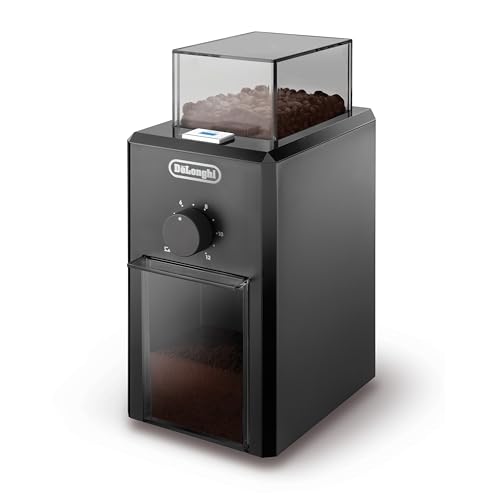
De'Longhi lists flat stainless steel burrs, 16 grind settings, a 120g hopper, a 170W motor and a cup selector that grinds for 1 to 12 cups, in a body 13cm wide. Coffee Kev's view, from a 2021 rundown of grinders under £200, is that it and its near twins from Krups and Melitta do not really have burrs as he would define them, more grinding wheels that crush the beans. That leaves more very fine and very coarse pieces than a better grinder would.
It grinds fine enough for espresso in pressurised baskets, Coffee Kev says, but not for standard baskets, and there are not enough settings to dial in espresso properly. There is a home modification to move the burrs closer, which Coffee Kev mentions and Tom's Coffee Corner has filmed on the sister KG89, but it means taking the grinder apart. Treat it as a cafetière and filter grinder.
Hoffmann's verdict on this class of grinder is harsh. He tested four electric burr grinders at around £50 in 2020 and found them loud and plagued by static, with filter coffee that was drinkable but muddy next to a good grinder. His advice was to save for an entry-level Wilfa or Baratza. Skip the KG79 if you can stretch to the Encore ESP.
Burr or blade: does it matter?
Yes. A blade grinder, about £20, spins blunt blades that smash the beans, and the longer you run it the finer it gets. Hoffmann's beginner's guide to grinders explains the problem: you have no real control over grind size, and the smashing creates a lot of very fine pieces that add muddiness and bitterness to the cup. His advice if you own one is to keep it for spices.
A burr grinder crushes the beans between two cutting surfaces, and the gap between them sets the size, so you can repeat a setting tomorrow. Conical burrs, as in the Sage and the Baratza, are the norm at this price because they need less motor power than flat burrs, Hoffmann explains. Some people prefer the extra texture conical burrs give espresso; others prefer the clarity of flat burrs. For a first grinder, Hoffmann says, it is not worth worrying about.
Stepped or stepless: which do you need for espresso?
Either works, as long as the steps are small enough in the espresso range. Hoffmann explains that a small change in grind size makes a big change to how an espresso runs, which is why dedicated espresso grinders tend to be stepless: you can set the burrs anywhere. Steps are repeatable and easier to live with, and for filter coffee they are plenty.
Both of the espresso-capable picks here are stepped. Hoffmann reckoned each step on the Encore ESP and the Smart Grinder Pro changes a standard 18g espresso by about four or five seconds of brew time, which is fine enough to dial in. The KG79 has 16 steps across its whole range, according to De'Longhi, and Coffee Kev says that is not enough to dial in espresso even after modification.
Which grinders can really grind fine enough for espresso?
Only some, and the box will not tell you which. Pressurised (dual wall) baskets, the kind many entry-level machines come with, create the resistance themselves and forgive a coarse grind. Unpressurised baskets need a fine, even grind and a grinder that can make small adjustments. A grinder that claims espresso may only mean the first kind.
| Grinder | Unpressurised espresso baskets? | Source |
|---|---|---|
| Sage Smart Grinder Pro | Yes, best with medium to dark roasts | Coffee Kev, James Hoffmann |
| Baratza Encore ESP | Yes | James Hoffmann, Lance Hedrick, Coffee Kev |
| De'Longhi KG79 | No, pressurised baskets only | Coffee Kev |
| Smeg espresso-style grinder, about £220 | No, it cannot grind fine enough | James Hoffmann |
The Smeg line is the warning. Hoffmann bought one for his under-£250 test, found it was designed for pressurised portafilters and could not grind fine enough for espresso, and left it out of the comparison: 'I do not recommend that grinder in any way.' Price and looks are no guide.
Which grinder you need also depends on the machine. The Sage Bambino Plus comes with both kinds of basket, and Coffee Kev's suggested grinders for it include the Sage Smart Grinder Pro and the Baratza Encore ESP. The De'Longhi Dedica EC685 builds its pressurisation into the portafilter, so a better grinder only pays off with an aftermarket portafilter, as Coffee Kev explains.
How do the three compare on paper?
The Sage Smart Grinder Pro is the biggest and the only one with a programmable timer; the Baratza Encore ESP and the De'Longhi KG79 are both 13cm wide, against 21.5cm for the Sage, according to Baratza, De'Longhi and Sage.
| Spec | Sage Smart Grinder Pro | Baratza Encore ESP | De'Longhi KG79 |
|---|---|---|---|
| Amazon price | £189.00 | £159.95 | £51.98 |
| Burrs | Conical steel burr | Conical steel burr | Flat steel burr |
| Grind settings | 60 | 40 | 16 |
| Dosing | Timed, 0.2 second steps | Manual | Cup selector, up to 12 cups |
| Hopper (g) | 450 | 300 | 120 |
| Rated power (watts) | 165 | 70 | 170 |
| Height (cm) | 38.9 | 34 | 26 |
Rated power is not what these grinders draw. Hoffmann measured the Smart Grinder Pro at 188W against its 165W rating, and the Encore ESP at more than 130W against 70W. Hoffmann's point is that it matters if you are adding up the load on one extension lead.
What does grinding your own coffee save?
About 8p a cup on our prices, and a grinder takes a while to pay for itself on that alone. The median whole bean coffee we track costs 63p a cup on an 18g dose, across 812 products; the median ground coffee costs 71p across 483. At two cups a day that is £58.40 a year saved.
| Grinder | Price | Cups to pay for itself | At two a day |
|---|---|---|---|
| Sage Smart Grinder Pro | £189.00 | 2,363 | About 3 years 3 months |
| Baratza Encore ESP | £159.95 | 2,000 | About 2 years 9 months |
| De'Longhi KG79 | £51.98 | 650 | About 11 months |
Retention eats into that. If you purge 2g each morning, the middle of Coffee Kev's 1 to 3g figure for the Smart Grinder Pro, you throw away 730g of beans a year, about £26 at the median bean price of roughly £35 a kilo. Single-dose grinders with low retention, like the Encore ESP, waste less.
Running costs are otherwise close to nothing. There are no filters or descaling. Sage asks you to clean the burrs with the brush supplied and not to put any part in the dishwasher, and Coffee Kev says the Smart Grinder Pro's burrs last a long time, with the upper burr adjustment there to compensate as they wear.
Who should skip all of these?
- Anyone with a Sage Barista Express or a bean-to-cup machine: the grinder is already built in.
- Anyone with a pod machine. Capsules arrive ground and sealed.
- Espresso enthusiasts chasing clarity of flavour. Hoffmann's favourite espresso under £250 came from the DF54, a flat burr grinder at about £246, though he found it messy unless you spray the beans with a little water first.
- Filter drinkers happy to turn a handle. Hoffmann's guide makes the point that a hand grinder spends its money on burrs rather than a motor, so it grinds better for the price.
- Anyone who grinds while the rest of the house sleeps. Hoffmann found the Encore ESP loud enough to be close to a deal-breaker for him.
The verdict
Buy the Sage Smart Grinder Pro if you want one easy grinder for espresso and filter and like a timer to do the dosing. Buy the Baratza Encore ESP if espresso is most of what you make and you can live with the noise. Buy the De'Longhi KG79 only for cafetière and filter, and only if £50 is the budget; Hoffmann would tell you to save up.
- Sage, the Smart Grinder Pro product page (UK), technical specifications165W, stainless steel conical burrs, 450g hopper, grind time adjustable in 0.2 second steps, 50 to 54mm and 58mm portafilter cradles, 21.5 x 16 x 38.9cm, 2 year repair, replace or refund guarantee, £209.95.
- Sage, the Smart Grinder Pro instruction book (BCG820/SCG820)Settings 1 to 30 for espresso, 31 to 45 percolator, 46 to 54 drip filter, 55 to 60 plunger; start espresso at 12; the adjustable upper burr; switch-off after 5 minutes idle; 20 minutes to cool after overheating; 2 year limited guarantee.
- Baratza UK, Encore ESP product page40mm conical steel M2 burrs, 550rpm, 300g hopper, 120g grounds bin, 70W, 1.3g a second at setting 10 to 2.2g at setting 30, 13 x 15 x 34cm, 2 year manufacturer warranty, £159.95.
- De'Longhi UK, KG79 grinder product pageFlat stainless steel burrs, grind size adjustable 1 to 16, 120g bean hopper, 150g grounds container, 170W, cup selector for 1 to 12 cups, 130 x 160 x 260mm, 1.5kg.
- James Hoffmann (YouTube), The Best Espresso Grinder Under £250 (November 2024)Baratza Encore ESP, Sage Smart Grinder Pro, Fellow Opus, Varia VS3 and DF54 compared for espresso, filter, retention, power draw and noise. A £220 Smeg grinder left out because it could not grind fine enough for espresso.
- James Hoffmann (YouTube), A Beginner's Guide to Coffee Grinders (June 2021)Blade grinders against burr grinders, conical against flat burrs, stepped against stepless adjustment, why cheap electric grinders struggle with espresso, and retention.
- James Hoffmann (YouTube), £50 Burr Grinders: A Bargain Or A Terrible Mistake? (September 2020)Four electric burr grinders at about £40 to £54: noise, static, muddy filter coffee next to a far dearer grinder, and his advice to save for an entry-level Wilfa or Baratza.
- Coffee Blog, Sage Smart Grinder Pro review after nine years of use (Kev Lewis)Espresso with traditional baskets, upper burr positions 1 to 10 set to 6 at the factory, 1 to 3g exchange retention, 60 to 65dB, the slipper clutch with dense light roasts, cheap sacrificial gears, a hopper he puts at about 250g, and no better for filter than cheaper grinders.
- Coffee Kev (YouTube), Baratza Encore ESP - Espresso Game changer? (May 2023)Micro steps for espresso on settings 1 to 20 and macro steps above, a dosing cup that fits 53 to 58mm portafilters, louder than Sage's grinders, low retention.
- Coffee Kev (YouTube), Best Coffee Grinders Under £200 (May 2021)The De'Longhi KG79, Krups Expert and Melitta Molino: grinding wheels rather than true burrs, fine enough for pressurised baskets but not standard ones, static, and a mod for finer grinding.
- Lance Hedrick (YouTube), NEW BARATZA ENCORE ESP REVIEW: Baratza Back On Top (February 2023)Settings 1 to 20 move the burr 18.8 microns a step and settings above 20 about 90 microns; no stalling with very light roasts; a loud grinder; plastic burr carrier.
- Tom's Coffee Corner (YouTube), Delonghi KG79 & KG89 Mod for Finer Grinding - The Easy Way (November 2021)A KG89 at its finest setting ran an espresso in under 20 seconds; after opening it up to move the burrs closer, a 30 second shot. Messy and full of static.
- Sage, the Bambino Plus product page (UK)ThermoJet heater ready in 3 seconds, PID, 1.9 litre tank, 1,600W, 19.4 x 36.2 x 30.4cm, single and dual wall baskets, hot water via the steam wand, 2 year guarantee, £399.95 RRP.
- Sage, the Barista Express product page (UK)15 bar pump with 9 bar extraction, Thermocoil and PID, 16 grind settings, 250g hopper, 2 litre tank, 1,850W, 31.8 x 35.1 x 40.4cm, 2 year guarantee, £629.95 RRP.
- Coffee Blog, Sage Barista Express reviewWhat the grinder can and cannot do, the adjustable upper burr, burr wear, and the pressure gauge's missing bar markings.
- Coffee Kev (YouTube), Sage (Breville) Bambino Plus Review After Nearly 4 YearsOwned since 2020: fixed 93°C brew temperature, 9 bar valve, drip tray and purge volumes, first-shot inconsistency, grinder pairings, milk settings.
- Coffee Kev (YouTube), Battle of The DeLonghi Dedicas, Which Is Best in 2024?The EC685 panarello, pressurisation built into the portafilter, no PID, and his value-for-money verdict.
- We Try Coffee catalogue, October 2026Pods median 52p a cup across 129 products. Nespresso Vertuo capsules: 13 products, median 85p, range 68p to £1.70. Nespresso's own Original capsules about 52p. Dolce Gusto: 10 products, median 21p. Whole beans 63p and ground coffee 71p on an 18g dose.
Questions people ask
What is the best coffee grinder for espresso under £250 in the UK?
The Baratza Encore ESP if espresso is the priority: James Hoffmann rated its espresso above the Sage Smart Grinder Pro's, and it was £159.95 on Amazon in September 2026. The Sage Smart Grinder Pro, at £189, is the better all-rounder if you also make filter coffee and want a timer that doses for you.
Can a cheap burr grinder grind fine enough for espresso?
Usually only for pressurised baskets. Coffee Kev says grinders around £40 to £50, such as the De'Longhi KG79, grind fine enough for pressurised espresso baskets but not for standard ones. James Hoffmann found a £220 Smeg grinder could not grind fine enough for espresso either. The Baratza Encore ESP is the cheapest grinder in our shortlist that can.
Is a burr grinder better than a blade grinder?
Yes. A blade grinder smashes the beans, gives you little control over grind size and creates many very fine pieces, which James Hoffmann says add muddiness and bitterness. A burr grinder crushes beans between two cutting surfaces set a fixed distance apart, so the grind is more even and you can repeat a setting.
Do I need a stepless grinder for espresso?
No, as long as the steps are small in the espresso range. The Baratza Encore ESP and Sage Smart Grinder Pro are both stepped, and James Hoffmann estimated each step changes a standard espresso by about four or five seconds of brew time, which is fine enough to dial in. Dedicated espresso grinders tend to be stepless for finer control.
Do I need a separate grinder for a Sage Barista Express?
No. The Sage Barista Express has a conical burr grinder with 16 settings built in, according to Sage. Coffee Blog says that grinder can struggle to go fine enough for light-roasted coffee, so a separate grinder only earns its place if that is what you buy. A Sage Bambino Plus, by contrast, has no grinder.
How much does grinding your own coffee save?
About 8p a cup. The median whole bean coffee we track costs 63p a cup on an 18g dose, against 71p for ground coffee. At two cups a day that is £58.40 a year, so a Sage Smart Grinder Pro at £189 takes a little over three years to pay for itself on price alone.
Keep reading